One view of a user's crypto accounts, and card spend from a self-custody wallet without custody.
GitHub Repository
Requirements, design, roadmap
Documentation Set
Approved v1.0 · 26 documents
PRD — Card Spend
Start here: the card flow
Project Status
Requirements and design are approved: version 1.0, tag docs-v1.0, 2026-10-04.
Implementation has not started; there is no running service and no demo.
Next milestone: S1 — Contracts (v0.1.0). Order, versions and log:
roadmap.
Problem
A custodial crypto card makes the user pre-fund a balance the issuer controls.
A card authorization must be answered within 2–3 seconds, but an ERC-20 token has no hold and the wallet is not under the platform's control.
The same authorization can arrive twice and must not charge the cardholder twice.
Consuming systems need one view of a user's crypto accounts across exchanges and self-custody wallets.
Scope
- Card spend: on-chain debit wallet → treasury at authorization time. No pre-funding, no custody.
- Authorization API for an issuer processor, HTTP/JSON, modelled on JIT Funding: authorize, reverse, refund, status.
- Spend contract: debit with expiry, refund, daily limit, roles, pause. Holds no tokens.
- Exchange accounts, read-only: Binance balances (spot, funding, Earn) and history.
- Canonical ledger for exchanges and chains; reconciliation against the on-chain balance.
- gRPC API for consumers, multi-tenant. First consumer: Expense Tracker.
Design Highlights
| Topic | Decision |
|---|---|
| Non-custodial card spend | Token allowance on the cardholder's wallet. Tokens move wallet → treasury at authorization; the contract holds nothing. ADR-9, PRD |
| Synchronous card, asynchronous chain | Approve only after the debit is preconfirmed or included. Deadline → decline. Every debit expires on-chain; a late debit is refunded automatically. ADR-12 |
| No double debit | Three independent layers: request idempotency, nonce stored before send, single-use authId in the contract. SRS — Card Spend |
| Bounded platform power | Exchange keys are read-only. The only key that can move tokens lives in a separate binary. It can move them only wallet → treasury within allowance and daily limit, and back as refunds. ADR-3 |
| One ledger for exchanges and chains | Canonical entries with legs, idempotent import, raw record kept, incremental pull by sequence. ADR-5, SRS — Core |
Exchange integration, on-chain indexing and real-time signals: design highlights in the README.
System Context
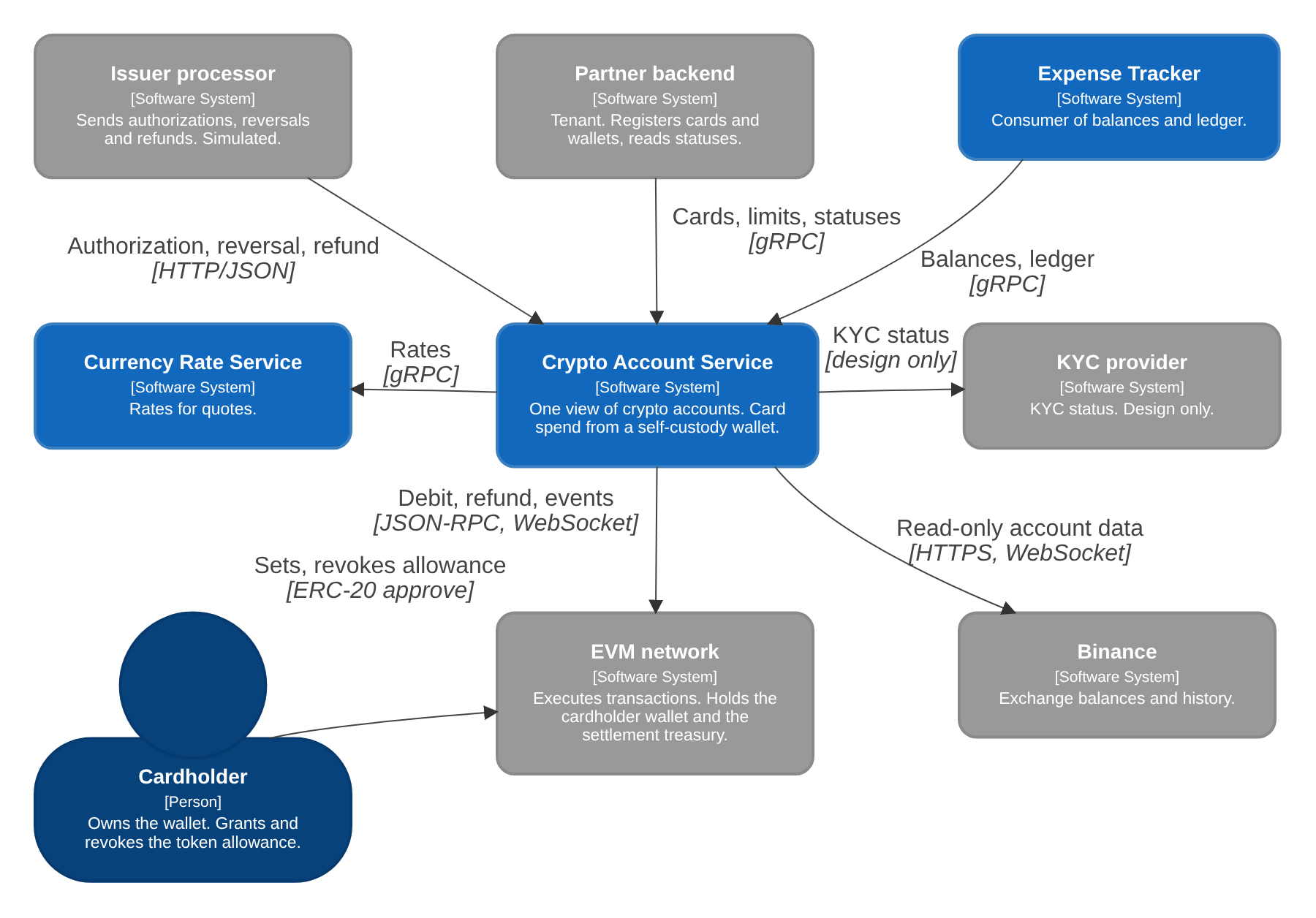
Rendered from docs/c4/context.md (docs-v1.0) in the Mermaid live editor; title removed, relation labels repositioned. Context and container diagrams in the repository
Card Authorization Flow
sequenceDiagram
    autonumber
    participant P as Issuer processor
    participant A as card-auth
    participant R as CRS
    participant N as EVM network
    participant S as server (indexer)

    P->>A: Authorize(auth_id, card_ref, amount)
    A->>A: Idempotency, card status, limit
    A->>R: Rate, if currency is not USD
    A->>N: Read balance and allowance
    alt a check fails
        A-->>P: DECLINED + reason
    else all checks pass
        A->>N: debit(wallet, amount, authId, validUntil)
        N-->>A: Preconfirmed or included
        A-->>P: APPROVED
    end
    Note over A,S: Asynchronous part
    N-->>A: Finality reached → debit confirmed
    S->>N: Read Debited event
    S->>S: Ledger entry, reconciliation
Source and edge cases EC-1 … EC-12: PRD — Card Spend §3.3.2
Boundaries
CAS never holds user funds and never signs for the cardholder.
CAS never trades or withdraws on exchanges and never serves rates.
CAS stores no personal data: the owner is an opaque reference.
Test networks only: Anvil and Base Sepolia. No mainnet.
No real keys and no real balances.
Exchange access is read-only.
Documentation Set
BRD, 2 PRDs, 4 SRS, 13 ADRs, C4 context and containers, glossary, roadmap. 26 documents, about 4,500 lines. Markdown in the repository.
Traceability: business goal → business requirement → user story → functional requirement. Each functional requirement is one testable statement.
Map, conventions and identifiers: docs/README.
| Time | Read |
|---|---|
| 5 minutes | BRD §2–§4 and the context diagram |
| 20 minutes | PRD — Card Spend, ADR-9, ADR-12 |
| 1 hour | SRS — Card Spend, then SRS — Core |
Milestones
| ID | Content |
|---|---|
| S1 | Contracts CardSpendController and MockUSDC, tests on a local chain |
| C1 | Core: tenants, connections, encrypted secrets, gRPC API, CI |
| S2 | card-auth: end-to-end authorization locally, then on Base Sepolia |
| S3 | Event indexer into the ledger; reconciliation |
| X1 | Binance balances: spot, funding, Earn; key permission check; rate limiter |
| X2 | Binance history; backfill and incremental sync; completeness check |
| W1 | Real-time triggers from Binance account events |
Outlined in the BRD: second exchange, Kraken, Expense Tracker integration. Status of each milestone: roadmap.
How It Was Produced
Author-led, AI-assisted. Scope, decisions and review: the author. Text and diagrams: an AI assistant, following the author's templates. No document is accepted without the author's review. Details: README.
Related Services
Currency Rate Service: rates. CAS never serves prices.
Expense Tracker: first consumer of balances and history.
Tech Stack (planned)
Go
PostgreSQL
gRPC
go-ethereum
Solidity
Foundry
OpenZeppelin
Anvil
Base Sepolia
Docker