A ticket arrives over Kafka, an LLM with guardrails classifies it, DMN routes it, workers resolve it, and every failure mode is rehearsed and written down.
GitHub Repository
Models, workers, infra and docs
Runbooks
Incidents, migration, backup, rotation
Screencast
coming soon
Problem
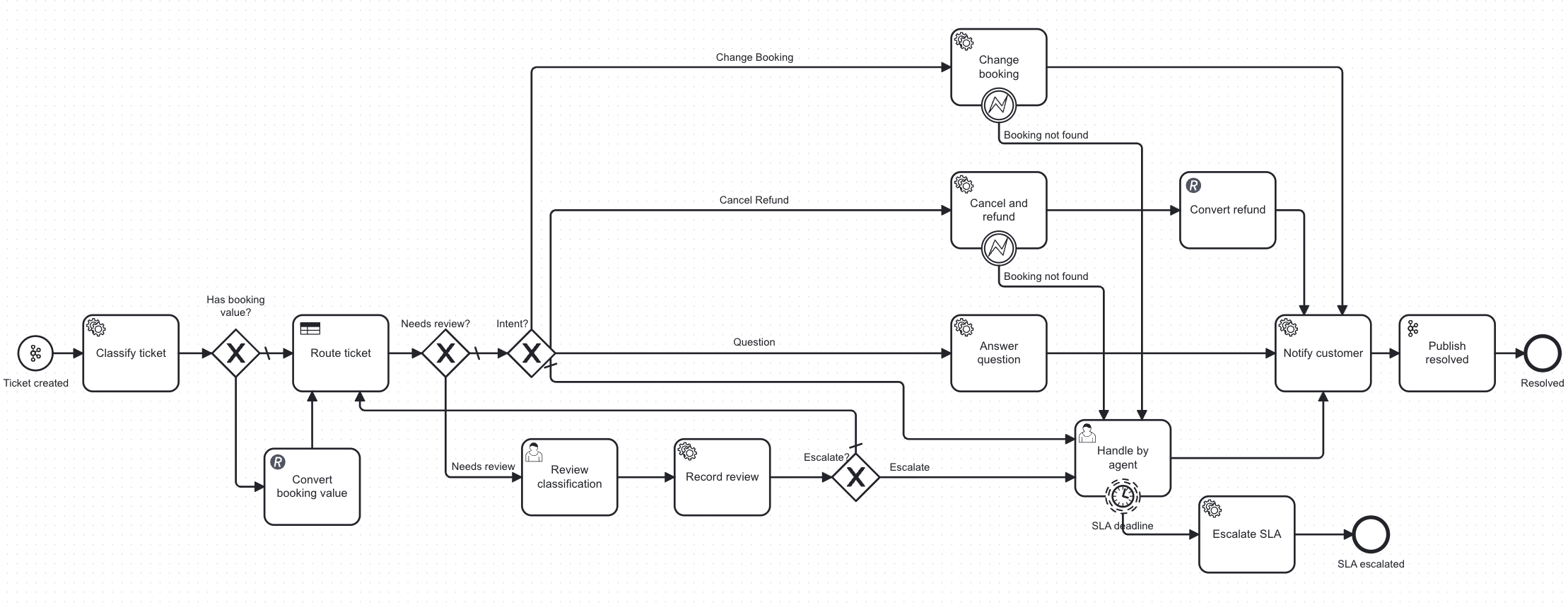
A travel booking company receives support tickets in English and Russian: booking changes, cancellations with refunds, and general questions. Each ticket has to be classified, routed to the right team with a priority and an SLA deadline that depends on customer tier and booking value, and refunds need a booking lookup and a currency conversion before the customer is notified. In plain code these rules end up scattered across services, a stuck refund is a line in a log, and changing an SLA means a redeploy. A BPM engine makes every ticket a visible process instance, keeps routing and SLA policy in DMN tables that change without code, turns failures into incidents an operator can retry or migrate, and lets the SLA timer live in the model itself.
What It Proves
| Requirement | Evidence |
|---|---|
| BPMN processes and DMN decision tables in Camunda 8 | processes/, decisions/, DMN test matrix (18 cases) |
| Greenfield process plus ongoing improvements | process changelog v1→v10 in the process design, migration runbook |
| LLM classifier with configurable prompts | workers/llm-classifier/, prompts/, accuracy report |
| AI/LLM guardrails | LLM guardrails overview, classifier design |
| Support and debug in Operate, quick fixes in production | incident-handling runbook, timeout runbook |
| REST / JSON / Kafka integrations | Kafka and REST connectors, workers/booking/, services/fx-gateway/, integrations design |
| Operations on production-like systems | install, backup and restore, upgrade, password rotation, monitoring profile |
Architecture
flowchart LR
    subgraph external["External"]
        claude["Claude API"]
        ecb["frankfurter.app (ECB rates)"]
    end

    subgraph vm["Single VM — Docker Compose"]
        subgraph core["core profile"]
            camunda["Orchestration Cluster
(camunda/camunda 8.9)
Zeebe + Operate + Tasklist + Admin"]
            connectors["Connectors 8.9"]
            es[("Elasticsearch
secondary storage")]
        end
        subgraph integrations["integrations profile"]
            kafka["Kafka (KRaft, single node)"]
            bookingapi["booking-api (Go, mock)"]
            fxgw["fx-gateway (Go)"]
            pg[("PostgreSQL
LLM audit + analytics")]
        end
        subgraph workers["workers profile"]
            wbooking["worker-booking (Go)"]
            wclassifier["worker-llm-classifier
(Python SDK)"]
        end
        subgraph monitoring["monitoring profile"]
            prom["Prometheus"]
            graf["Grafana"]
        end
    end

    kafka -- "support.ticket.created (inbound connector)" --> connectors
    connectors -- "support.ticket.resolved (outbound connector)" --> kafka
    connectors -- "REST /convert" --> fxgw
    fxgw --> ecb
    wbooking -- "REST v2: long-poll jobs" --> camunda
    wbooking -- "HTTP/JSON" --> bookingapi
    wclassifier -- "REST v2: long-poll jobs" --> camunda
    wclassifier -- "classify / answer / notify" --> claude
    wclassifier -- "audit" --> pg
    camunda --> es
    connectors --> camunda
    prom --> camunda
    graf --> prom
Screenshots
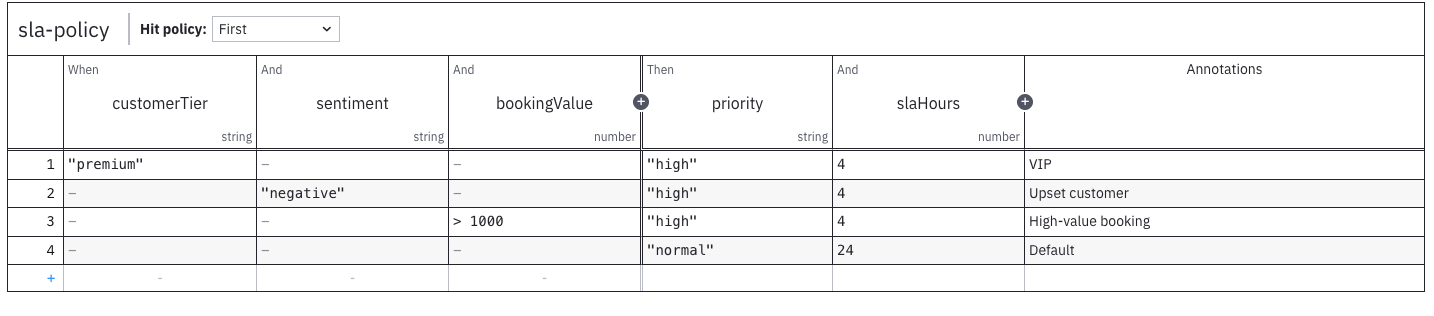
sla-policy table: priority and SLA hours by tier, sentiment and booking value — routing design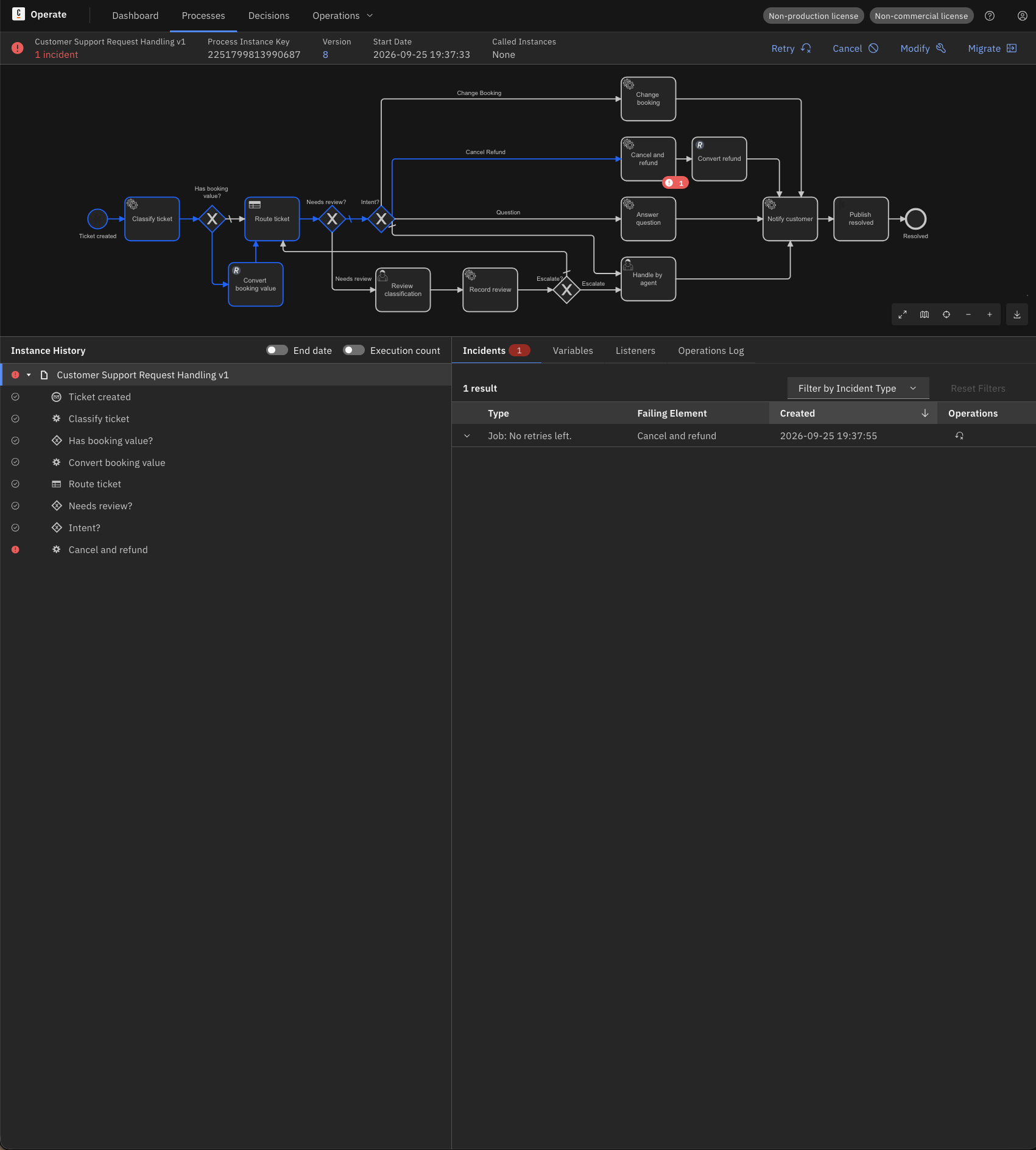
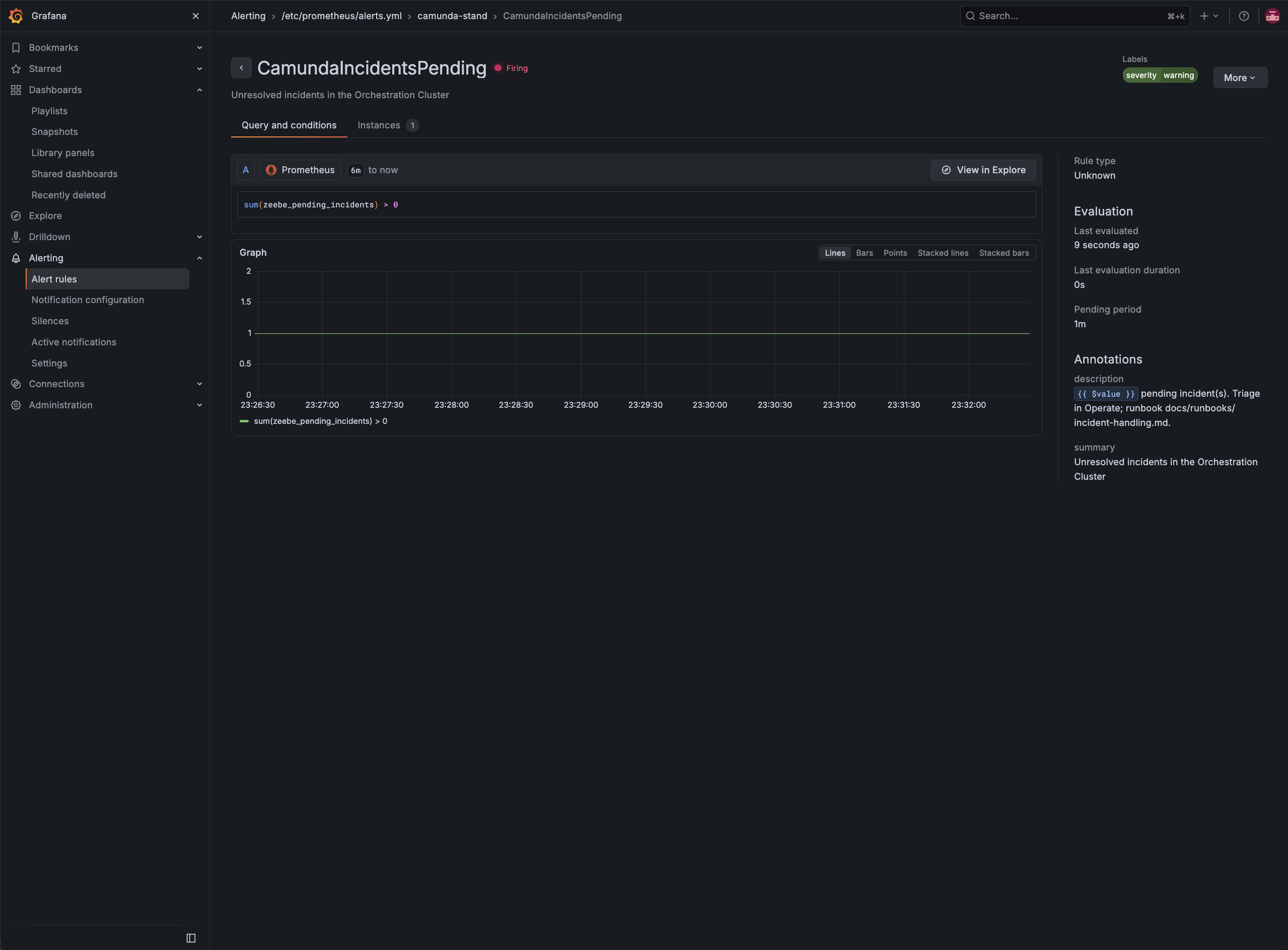
CamundaIncidentsPending firing on a live incident — monitoring design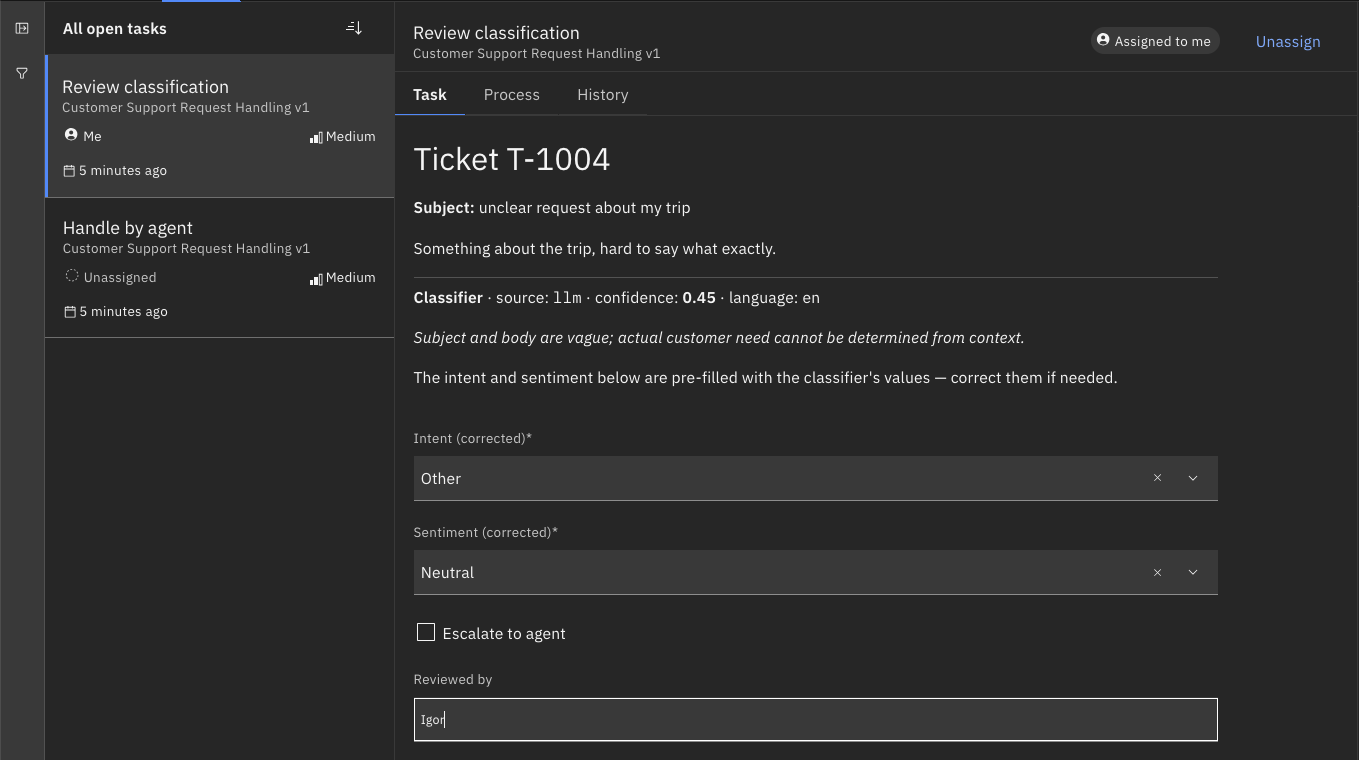
Operations
Incident handling — bad data, downstream outage, configuration errors resolved in place; plus the timeout and SLA escalation variants.
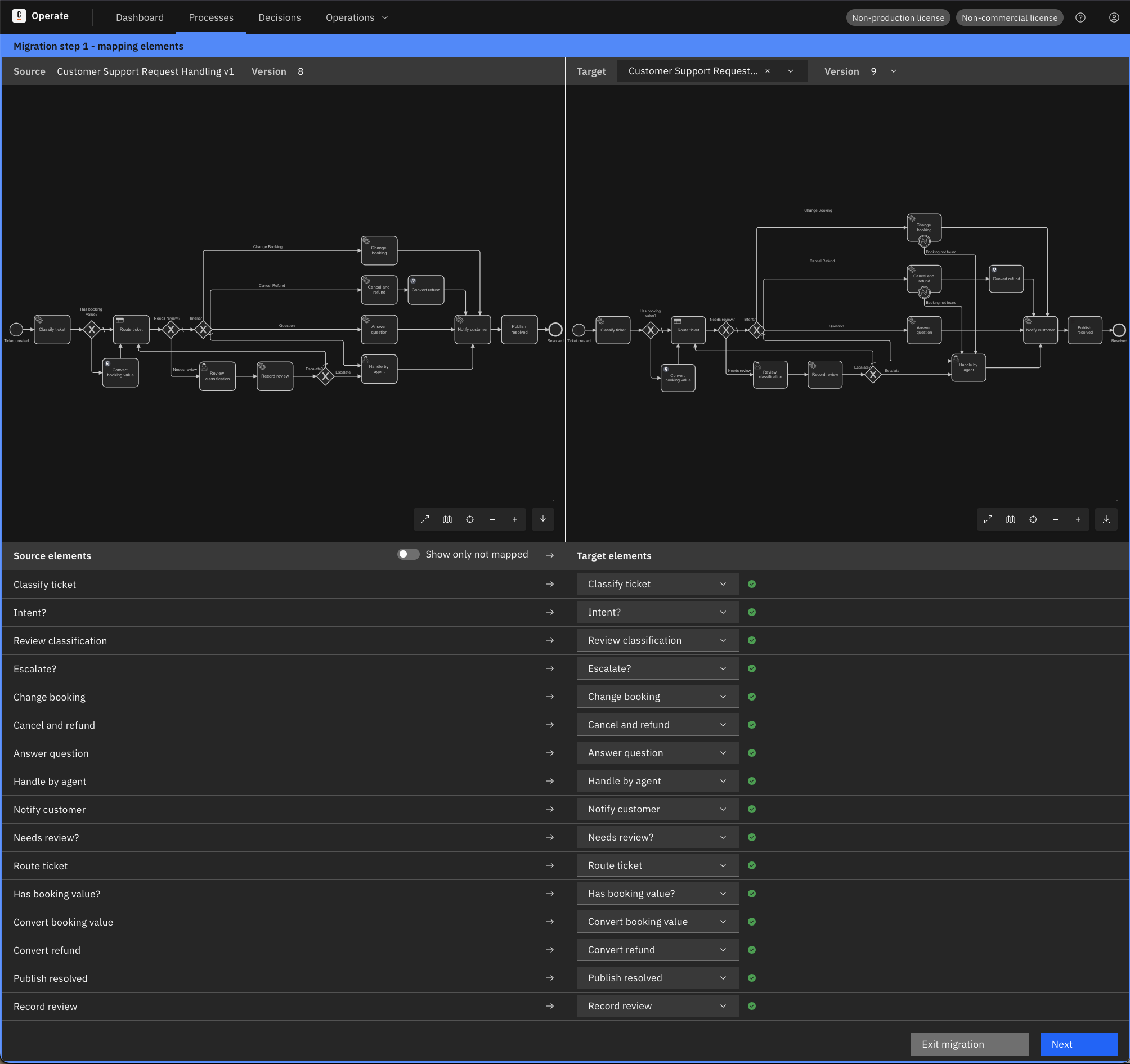
Instance migration — the model was wrong: fix it in a new version, move the live instance, resolve the incident.
Backup and restore — Zeebe, Elasticsearch and PostgreSQL, rehearsed in three round-trips.
Upgrade — patch path 8.9.19 → 8.9.21 rehearsed on a disposable lab with waiting instances.
Password rotation — the scoped worker user rotated on the running cluster without losing jobs.
Monitoring — Prometheus and Grafana profile with the pending-incidents alert.
Findings
A profile that is only in .env.example is not deployed. The monitoring profile sat unused for four phases — lessons learned
The incident gauge is zeebe_pending_incidents, not _total. A live scrape corrected the design before the alert went in — operations design §2
A search answering 200 proves credentials, not permissions. Least privilege is proven by job activation, not by a search — install, Workers
The search API lags the engine. Only the write's answer is authoritative — lessons learned
Identity indices are in no snapshot of the backup set. Verify the worker user after any restore — backup and restore §6
Origin
This is v2 of the Camunda LLM Ticket Refund demo, which ran a single refund process on Camunda 7.21 with an OpenAI worker through the External Task pattern. v2 moves to Camunda 8.9 Self-Managed and widens the scope from one refund flow to the whole support desk: Kafka as the entry point, routing and SLA policy in DMN, a Claude-based classifier with schema validation, fallback and human review, REST integrations through connectors and Go workers, and a rehearsed operations layer — incidents, instance migration, backup and restore, upgrade, monitoring and least privilege.
Tech Stack
Camunda 8.9 Self-Managed
BPMN / DMN / FEEL
Kafka
Claude API
Go
Python
PostgreSQL
Elasticsearch
Prometheus
Grafana
Docker Compose